


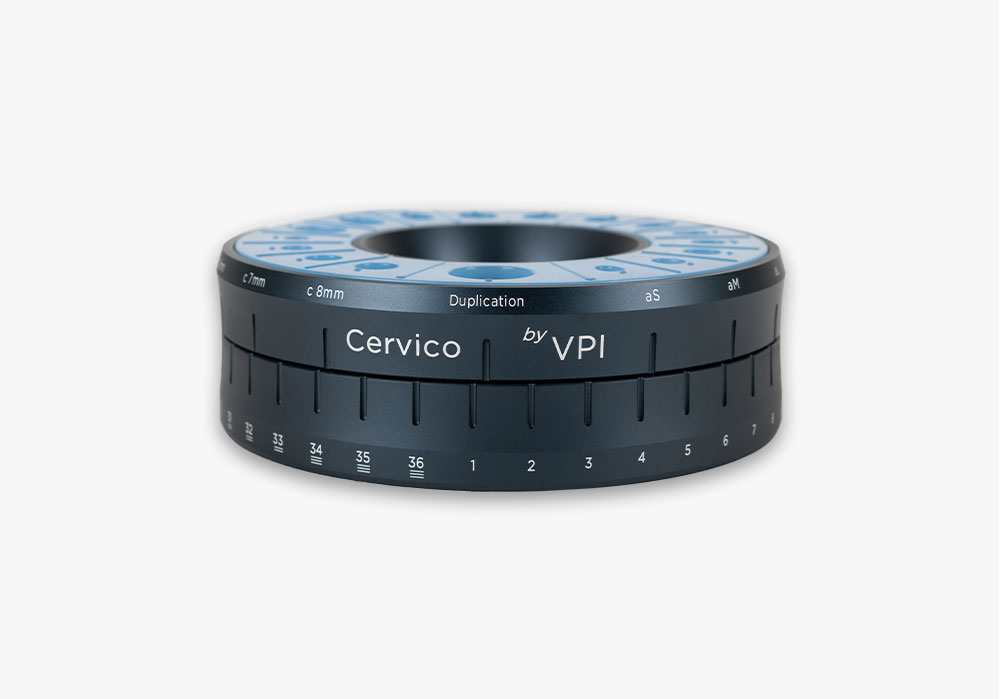



The Cervico Premium Kit is a custom healing abutment kit for conventional impression workflows: the Cervico Guide for diagnosis plus the Premium Mold, which locks your implant’s prosthetic connection with VPI Prosthetic Connection Inserts.
How the custom healing abutment kit works
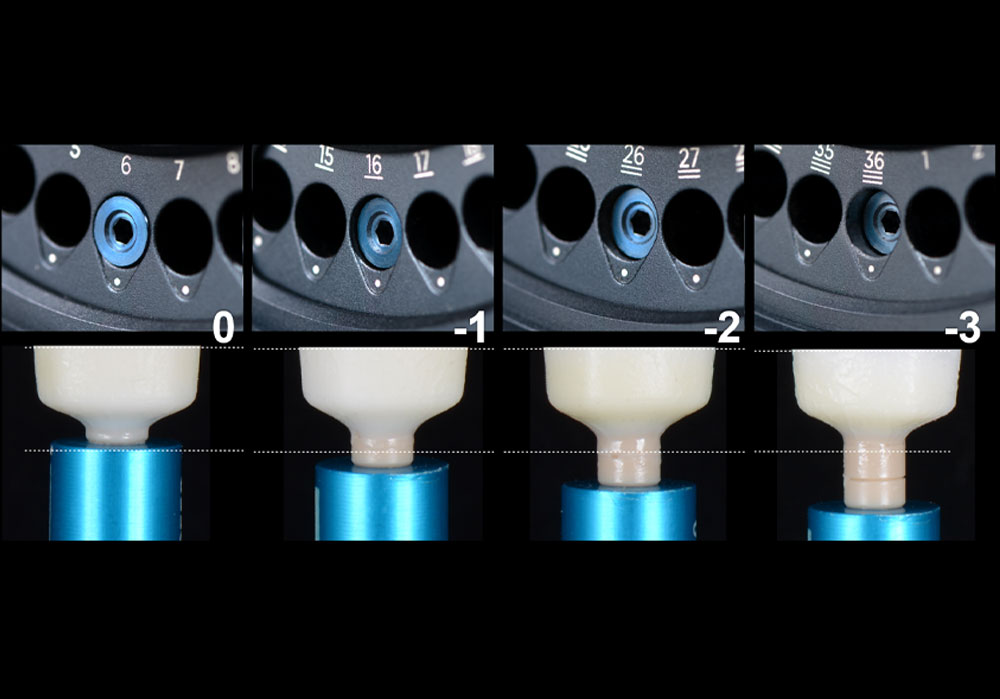
The Cervico Premium Mold uses interchangeable VPI Prosthetic Connection Inserts to lock abutments in place. This gives you fixed buccal orientation (hex flat always facing buccal), precise insertion depth control in 1mm increments across four socket groups (crestal, 1mm sub, 2mm sub, 3mm sub), and true 1:1 duplication onto impression posts for conventional open or closed tray impressions. Your assistant can pre-fabricate surgery-ready abutments in advance.
The VPI Prosthetic Connection Insert included with your Premium Mold lets you match your exact implant placement depth. Drop it into the socket group that corresponds to how you placed the implant:
- Sockets 1-12: crestal placement
- Sockets 13-24: 1 mm sub-crestal
- Sockets 25-33: 2 mm sub-crestal
- Sockets 34-36: 3 mm sub-crestal
Once installed, the insert stays in the mold. You only need to remove and reinstall it if your placement depth changes.
Optional: if you work at multiple depths with the same implant connection, purchase additional inserts and keep one pre-installed at each depth, no swapping mid-case.
Two silicone inserts for every clinical scenario
The mold includes two interchangeable silicone inserts. The centered insert contains 12 anatomical wells derived from natural tooth cervical profiles, 4 cylindrical wells, and 1 duplication well for impression transfer. The off-centered insert adds 12 off-centered wells for cases where the implant is not centered under the planned restoration. You choose which insert to use based on the bore position identified with the Guide during evaluation.
The Guide as the planning companion
The Guide features 12 anatomical tabs across four tooth groups (anteriors, premolars, square molars, elongated molars) in small, medium, and large, plus 8 cylindrical tabs (5–12mm). The cylindrical tabs evaluate the mesio-distal space and let you drill through the central bore with a pilot drill to center your osteotomy. The anatomical tabs then mount onto positioning pins placed in the osteotomy, so you can visualize the planned healing abutment relative to the site and verify implant position at every drilling step. Each tab code maps directly to a well in the mold.

